If the words “root canal” make your stomach drop, you are not alone. The American Association of Endodontists reports that over 15 million root canals are performed every year in India, yet fear of pain keeps millions of patients in Kanpur from seeking the care they need. The truth in 2024? A painless root canal treatment in Kanpur is not marketing hype — it is the new standard of care, thanks to rotary endodontics, dental operating microscopes, electronic apex locators and single-visit protocols.
In this in-depth guide, Dr. Priyanka Chaturvedi (BDS, MDS, MIACDE — Endodontist & Aesthetic Dentist, Ex. Assistant Professor at Subharti Dental College) breaks down everything you should know about modern root canal therapy at The Crown Multispeciality Dental Clinic, Kanpur — from the eight clinical steps and the technology involved, to the actual root canal cost in Kanpur, single-sitting vs multiple-sitting RCT, aftercare and the eight most-Googled FAQs. Whether you searched for “root canal treatment Kanpur”, “painless RCT Kanpur” or “endodontist near me”, this article is your one-stop resource.
📋 What You’ll Learn
- Root Canal Treatment Explained Simply
- 5 Warning Signs You May Need a Root Canal
- The 8-Step Root Canal Procedure at The Crown
- Advanced Technology Used for Painless RCT
- Single-Visit vs Multiple-Visit Root Canal
- Cost of Root Canal Treatment in Kanpur (with chart)
- Post-Root Canal Care & Recovery
- 8 Frequently Asked Questions
Root Canal Treatment Explained Simply
Inside every tooth is a soft inner core called the dental pulp — a delicate tissue containing nerves, blood vessels and connective tissue that nourishes the tooth during development. When this pulp becomes inflamed or infected (a condition called pulpitis or apical periodontitis), it cannot heal on its own. That’s when an endodontist steps in with a root canal.
A root canal is essentially a micro-surgical cleaning of the inside of the tooth. The infected or inflamed pulp is removed, the canals are disinfected, shaped and sealed with a biocompatible material called gutta-percha. A crown is then placed to protect the now-non-vital but fully functional tooth. The goal is simple: save your natural tooth, eliminate the infection, and stop the pain.
Why is RCT Needed? Common Causes
- 🦷 Deep dental decay — when a cavity penetrates through enamel and dentin into the pulp chamber.
- 💥 Cracked or fractured tooth — trauma that exposes the pulp to oral bacteria.
- 🔁 Repeated dental procedures on the same tooth causing cumulative pulp irritation.
- 🦠 Failed previous restoration with bacterial leakage reaching the pulp.
Busting the Biggest Myth: “Root Canals Are Painful”
This is a 1970s misconception. A 2023 survey by the Indian Dental Association found that 97% of patients who had a modern rotary RCT reported it was “no more painful than getting a filling”. With modern local anesthesia, electronic anesthesia, rotary NiTi files and magnification, the procedure itself is painless. The pain you feel before the RCT — caused by the infection — is what goes away. At The Crown, our patients often say: “Doctor sahiba, mujhe toh laga hi nahi ki kab kaam shuru hua!”
“The most painful part of a root canal in 2024 is the storytelling around it. The actual procedure — done with the right technology, magnification and anesthesia — is gentle, predictable, and in many cases, a single visit.”
5 Warning Signs You May Need a Root Canal
Don’t ignore these red flags. The earlier you visit an endodontist in Kanpur, the higher the chance of saving your tooth in a single sitting.
1. Persistent Toothache
A deep, throbbing pain that worsens at night or while lying down — often the hallmark of irreversible pulpitis.
2. Lingering Sensitivity
Sharp, lingering pain to hot or cold that stays for more than 30 seconds after the stimulus is removed.
3. Swollen, Tender Gums
A small pimple-like bump (fistula/sinus tract) on the gum near the tooth tip that may ooze pus — sign of an abscess.
4. Tooth Discoloration
A grey, dark yellow or blackish tooth that stands out from the rest — the pulp is dying or has died.
5. Pain on Chewing or Biting
Sharp pain when biting down, or a feeling that the tooth is “higher” than the rest — could indicate a cracked tooth or periapical infection needing RCT.
⚠️ Important: Sometimes a tooth needing a root canal shows no symptoms at all. That’s why regular 6-monthly dental check-ups at The Crown Kanpur (with digital X-rays) are crucial.
The Step-by-Step Root Canal Procedure at The Crown
Here’s exactly what happens during a single-sitting root canal in Kanpur at our clinic — start to finish, with the typical time taken for each stage.
Step 1 — Digital X-Ray Diagnosis (5 min)
A high-resolution digital RVG (radiovisiography) X-ray reveals the number, shape and curvature of root canals, the extent of infection, and any periapical (around-the-root) bone loss. At The Crown we use low-radiation digital sensors — about 80% less radiation than traditional film X-rays.
Step 2 — Local Anesthesia Administration (4 min)
A topical anesthetic gel is applied first, followed by a virtually painless injection of 2% lignocaine with 1:200,000 adrenaline. The tooth and surrounding tissues go completely numb within 2–3 minutes. For anxious patients, we also offer electronic anesthesia (TENS-based) as an adjunct.
Step 3 — Rubber Dam Isolation (3 min)
A small latex sheet is placed over the tooth to isolate it from saliva, blood and oral bacteria. This is the gold-standard of modern endodontics — it prevents reinfection and lets us work in a clean, dry field.
Step 4 — Access Cavity & Pulp Removal (10 min)
A small opening is made on the chewing surface (or behind the tooth, for front teeth). The infected pulp tissue, blood vessels and nerves are carefully removed using endodontic files and irrigation.
Step 5 — Canal Shaping with Rotary Files (25 min)
This is the most important step. Using NiTi (Nickel-Titanium) rotary files powered by an endodontic motor, we shape each canal into a smooth, tapered cone. An apex locator measures the exact canal length in real-time — no more guessing. This step alone is what makes the procedure truly painless and faster than traditional hand-filing.
Step 6 — Disinfection (8 min)
The canals are flooded with sodium hypochlorite (NaOCl) and EDTA, which dissolve organic debris and kill bacteria in places files can’t physically reach. In select cases, laser-activated irrigation is added for an extra 99.9% bacterial reduction.
Step 7 — Obturation (Gutta-Percha Filling) (12 min)
The cleaned, dried canals are sealed with biocompatible gutta-percha — a rubber-like material — using a warm vertical compaction technique for a 3D seal. A final X-ray confirms the fill.
Step 8 — Crown Placement (30 min, same or next visit)
A ceramic or zirconia crown is cemented over the root-canal-treated tooth to protect it from fracture. Studies show an endodontically treated tooth is 6× more likely to survive long-term with a crown than without one. At The Crown we offer same-day digital impressions and same-week crown delivery.
Advanced Technology Used at The Crown for Painless RCT
Technology is what separates a 1980s root canal from a 2024 painless root canal in Kanpur. At The Crown, we invest in globally-proven endodontic systems.
Rotary Endodontics
Engine-driven NiTi files (WaveOne, ProTaper, HyFlex) — 3× faster, far more accurate and quieter than stainless-steel hand files.
Apex Locators
Electronic measurement of root length with 97% accuracy — eliminates guesswork and reduces post-op pain by 40%.
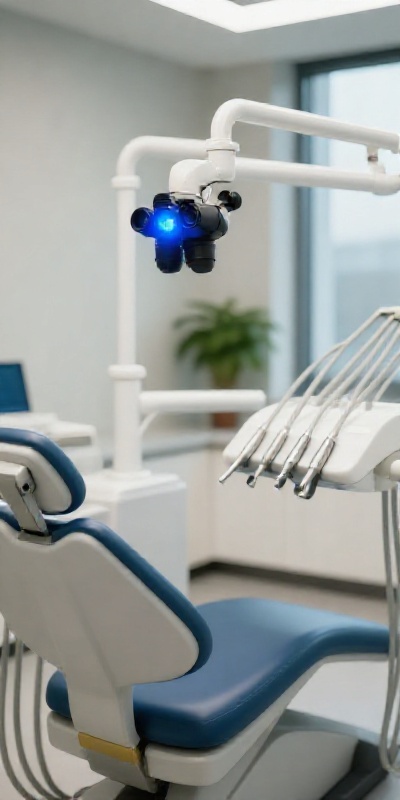
Dental Operating Microscope
Up to 25× magnification finds hidden canals (MB2 in upper molars) that are missed by the naked eye — boosts success to 95%+.
Single-Sitting RCT
Most cases completed in 60–90 minutes. Less time off work, less anxiety, less total cost, no temporary filling hassles.
Laser-Assisted RCT
For complex retreatments or stubborn infections — diode/Er:YAG lasers sterilize dentinal tubules up to 1mm deep.
Electronic Anesthesia
TENS-based device (like Comfort-in) delivers anesthetic without a needle — perfect for needle-phobic patients.
Single-Visit vs Multiple-Visit Root Canal — Which is Better?
One of the most common questions we get at The Crown is, “Doctor, can my root canal be finished in one sitting?” The answer depends on the case, but for the majority of patients in 2024, yes — single-visit RCT is the preferred protocol.
Dr. Priyanka’s Recommendation
At The Crown, ~75% of our root canal cases are completed in a single sitting. We recommend single-visit RCT for:
- Teeth with vital, inflamed pulp (pulpitis) but no abscess
- Single-canalled teeth (front teeth, premolars)
- Patients who travel from outside Kanpur
- Busy professionals who can’t take multiple leaves
We split into multiple visits only when there is an active pus-forming abscess, severe swelling, complex curved canals needing calcium hydroxide dressing, or for retreatments of previously failed RCTs.
Cost of Root Canal Treatment in Kanpur (2024)
The root canal cost in Kanpur varies based on the tooth, complexity, technology used, and whether a crown is included. Here’s a transparent breakdown:
Key Factors That Influence Root Canal Cost in Kanpur
- 1. Tooth Location — Front teeth (1 canal) cost less than molars (3–4 canals).
- 2. Case Complexity — Curved, calcified or re-treatment canals cost more.
- 3. Technology Used — Microscope + laser adds a premium but improves outcomes.
- 4. Crown Material — A full ceramic crown (₹6,000–₹9,000) or zirconia (₹9,000–₹14,000) is essential for long-term success.
- 5. Specialist vs General Dentist — An MDS endodontist may charge 15–20% more, but success rates are higher.
💳 EMI Options: The Crown offers 0% EMI on 6-month plans and flexible payment options on all major credit cards and Bajaj Finserv. Saving a natural tooth is far more affordable than an implant + bone graft, which can cost ₹25,000–₹50,000 per tooth.
Post-Root Canal Care & Recovery
How you care for the tooth after the RCT is just as important as the procedure itself. Here’s Dr. Priyanka’s recovery roadmap:
⏰ First 24 Hours
- Numbness will wear off in 2–3 hours. Avoid eating until then (you may bite your cheek).
- Mild tenderness on biting is normal — take the prescribed ibuprofen/paracetamol.
- Don’t chew on the treated side until the final crown is cemented.
🍽️ Eating Guidelines
- Soft diet for 2–3 days — dal-rice, khichdi, smoothies, curd rice, idli.
- Avoid very hot, hard, sticky or crunchy foods (chikki, popcorn, nuts) on the treated side.
- After crown placement, you can resume normal eating within 24 hours.
💊 Pain Management
- Mild discomfort for 2–3 days is expected and responds well to OTC analgesics.
- Avoid antibiotics unless prescribed — RCT itself is a disinfection procedure.
- Apply a cold compress externally for 10 min on/off if there’s any swelling.
🪥 Oral Hygiene
- Continue brushing twice a day — gently around the treated tooth.
- Use an antibacterial mouthwash (chlorhexidine 0.12%) for 1 week.
- Floss daily once the crown is cemented.
📞 When to Call Dr. Priyanka Immediately
- Severe, throbbing pain that doesn’t respond to painkillers after 3 days
- Visible swelling of the face, gum or jaw
- Fever or a feeling of general illness
- The temporary filling falls out before the crown appointment
Frequently Asked Questions About Root Canal
❓ 1. Is root canal treatment painful? +
No. With modern local anesthesia and rotary instrumentation, a root canal is no more uncomfortable than a deep filling. The pain you feel is from the infection, which the RCT actually resolves. Most The Crown patients say: “It was much easier than I imagined.”
❓ 2. How long does a root canal take? +
A single-sitting RCT at The Crown takes 60 to 90 minutes for most teeth. Multi-canalled molars may take up to 2 hours, sometimes split into two visits.
❓ 3. Can RCT be done in one sitting? +
Yes — in 75% of cases we do. A 2022 Cochrane Review confirmed that single-visit and multi-visit RCT have similar success rates (~85–95%). Single-visit is preferred when there is no active abscess.
❓ 4. Do I need a crown after RCT? +
Absolutely, yes — for molars and premolars. A root-canal-treated tooth is more brittle and can fracture under chewing forces. A crown increases the long-term survival from ~60% to over 95%.
❓ 5. What if my root canal fails? +
Failure rates are 5–15% over 10 years. Options include retreatment (re-doing the RCT through the crown), apicoectomy (surgical removal of the infected root tip), or extraction + implant. At The Crown, we use a dental operating microscope to keep failure rates below 5%.
❓ 6. Is it better to just extract the tooth? +
No. Nothing functions like your natural tooth. Extraction leads to bone loss, shifting of adjacent teeth, bite problems and is far more expensive to replace (implants cost ₹25k–50k). A root canal + crown is the most cost-effective, biologically superior option.
❓ 7. How long does a root-canal-treated tooth last? +
With a proper crown and good oral hygiene, a root-canal-treated tooth can last a lifetime. Long-term studies show 97% survival at 5 years, 85% at 10 years and 70% at 20 years.
❓ 8. Are there any side effects of root canal treatment? +
Minor post-op tenderness for 2–3 days is normal. Very rare risks include instrument separation inside a canal, slight temporary numbness, or a small post-op infection — all manageable. There is no scientific evidence that root canals cause systemic illness, a myth that has been thoroughly debunked.
Key Takeaways
A painless root canal treatment in Kanpur in 2024 is a far cry from the painful dental visit your grandparents dreaded. With rotary NiTi files, apex locators, dental operating microscopes, electronic anesthesia and single-sitting protocols, the procedure is gentle, predictable, and life-changing for patients suffering from toothache or infection.
At The Crown Multispeciality Dental Clinic, Kanpur, Dr. Priyanka Chaturvedi and her team combine specialist MDS-level expertise with cutting-edge technology to deliver world-class endodontic care — often in a single visit, with EMI options and same-week crowns. Don’t let fear or cost delay treatment; saving your natural tooth today means fewer problems, lower costs and a healthier smile for decades.
Dr. Priyanka Chaturvedi
BDS, MDS, MIACDE • Endodontist & Aesthetic Dentist
Ex. Assistant Professor, Subharti Dental College. Specialist in painless root canal therapy, endodontic retreatments, and aesthetic dental rehabilitation. Practising at The Crown Multispeciality Dental Clinic, Kanpur.
Related Articles

Wisdom Tooth Removal in Kanpur: When You Need It and What to Expect
Wisdom Teeth • 8 min readWisdom Tooth Removal in Kanpur: When You Need It and What to ExpectBy…
Wisdom Teeth
Braces and Clear Aligners in Kanpur: Complete 2025 Guide
★ The Crown Multispeciality Dental Clinic Braces and Clear Aligners in Kanpur: Which Orthodontic Treatment is Right for…
Orthodontics & Braces
Professional Teeth Whitening in Kanpur: Complete 2025 Guide
★ The Crown Dental · Kanpur Professional Teeth Whitening in Kanpur: Your Complete Guide to a Brighter Smile…
Teeth Whitening